Wednesday, January 8, 2014

SHOWING OFF


One of the lovely things about having a visitor is getting to do and see things long taken for granted. As we extended the sight-seeing into the late afternoon, we found ourselves at Watsons Bay and South Head. That's on your left as you sail into Sydney Harbour.

Storm clouds still hung over the city but were breaking to the east as we rounded the point to see the great Pacific Ocean disappear over the horizon.

Looking back to the city from Camp Cove as sea gulls lark and divers take a lesson ...


Walking up high now ...


On past Lady Jane Beach, another gorgeous (and nudist) little harbour beach as the sun was breaking through ...


Coming upon the georgian Lighthouse Keepers Cottage glimpsing the Manly Ferry heading to Manly (seven miles from Sydney, a thousand miles from care) ...


The two Km stretch across to North Head in the entrance to Sydney Harbour (Port Jackson) ...


All watched over by an old gunnery and the 1858 Hornby Lighthouse ...


Thursday, December 26, 2013

TOWN AND COUNTRY


Happy Days Everyone.

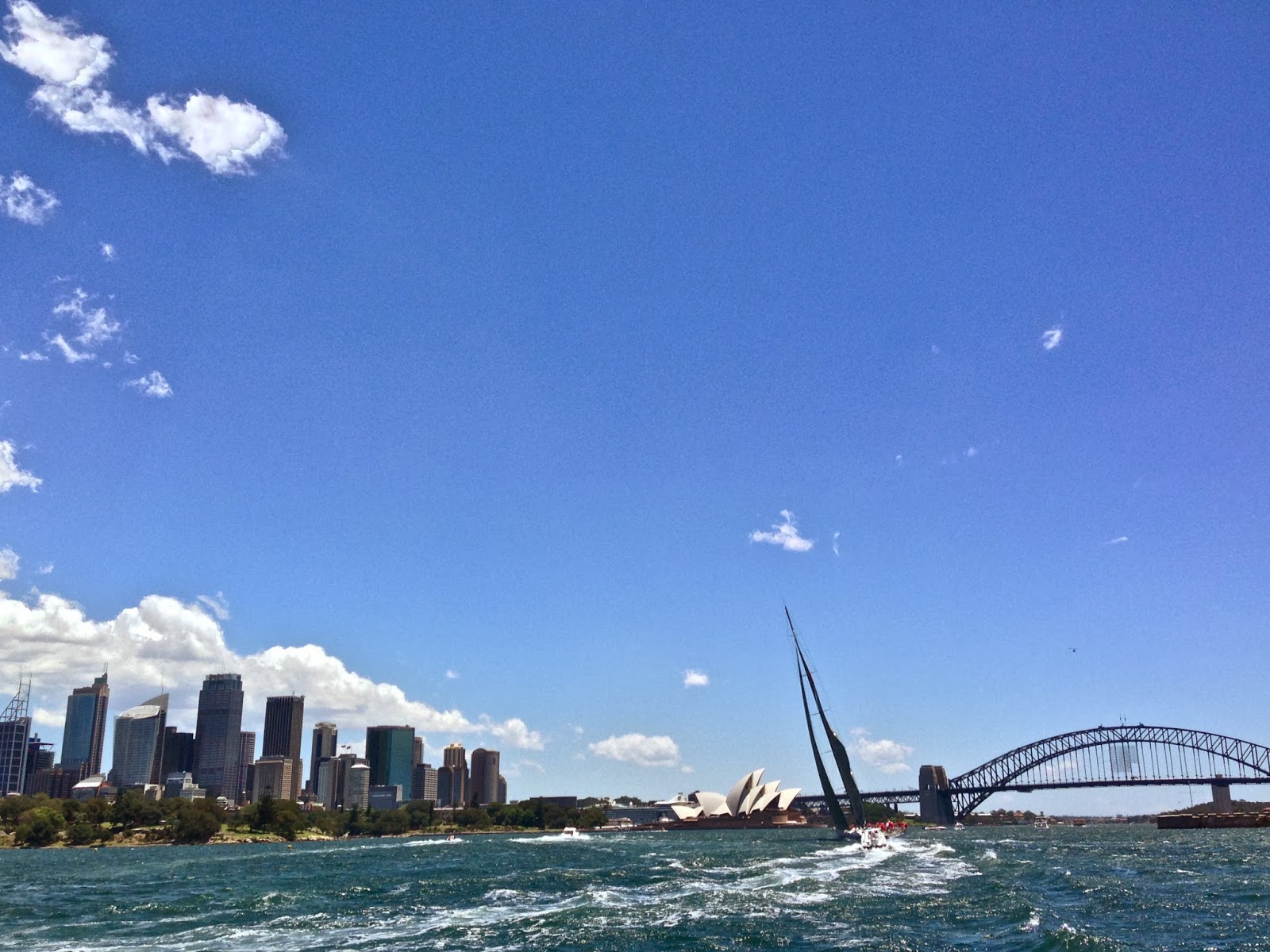
Last week on Sydney harbour ...


Christmas Eve in the village ...


Wednesday, December 25, 2013

DAS ENDE


A week exactly after Rheingold we were fronting up for Götterdämmerung. Knowing we'd be late at an after-party, we were already packed for a quick get-away the next morning. It was like it had ended before it had started, as is so often with Götterdämmerung - a late finish and an early start the next day to move on. Somewhere else. Leave it behind. Except I took a lot of this with me this time.

I'd link to the cast but in a brilliant stroke of genius, Opera Australia have removed all details of the Ring Performances and the Ring Festival from their website. Which is bloody irritating. On the Sunday morning we coughed up and went to a talk (there's one on each Sunday of each of the three cycles, but each with different participants) between OA chief Lyndon Terracini and Stuart Skelton (Siegmund) and the Wotan cover Shane Lowrencev.

Audience questions kept coming back to the production which Mr Terracini declined to comment on because he was interviewing director Neil Armfield on a subsequent Sunday (and a subsequent cycle) and couldn't preempt that. But, after prompting, he agreed to put the transcripts of that interview on-line, to the audible relief of those who, obviously, couldn't be there. And during an interval at Götterdämmerung I was given a firm assurance that it would happen. Well, if it did happen, it didn't happen for long. Thanks Lyndon.

So left with the published programme which has some brief Director's notes (along with four excellent essays about things Wagnerian and Ringy), here's the best I can give you of what Armfield has to say about his ideas:

* Love is exchnaged for wealth, and this is no arbitrary exchange

* The Ring is the story of a man "who recognises that the world is being destroyed by greed but is so compromised" by his own situation that he is unable to change anything, as are we all in one way or another.

* And "'it is essential'" wrote Wagner to August Röckel "'that everyone can recognise himself in Wotan'".

* Finally, the thematic message:
"But ours is a world in which species of animals and plants are being lost as they are being discovered. It's a world shaped by the mass movement of people escaping war or persecution or destruction of habitat. A world of miraculous developments of technology sitting on the most glaring inequalities of wealth and opportunity: the third world enslaved by the first.

One hundred and fifty years ago Wagner wrote The Ring as an incitement to both artistic and social revolution. He wanted the self-destructing world to be cleansed and to start over again. As we face deluge and conflagration in the 21st century, Wagner's götterdammerung is perhaps only a matter of time. He asks the essential question: is our love strong enough to save us?"


There's a short trailer which gives a look at the general feel of the staging - the Norns struggling to repair a fading tapestry of life; the Gibichungs in their noveau riche home gymnasium, the designer wedding in the marquee, the rifle club and the murder.


What was really starting to have an impact on me was how appropriate the casting was to the meaningfulness of this production. All were consistently in character in direction (and Neil Armfield is a genius at letting the actor evolve his own characterisation, under the 'gentle guidance', which is why it seems so from 'within') but also in voice. To that extent, this was one of if not the most satisfying of Ring experiences. I might well have heard some of the roles better sung, but there's more to it than that. Sometimes vocal imperfections (against an idealised perfect) are the more revealing.

I loved
the bitterness in Fyfe's Alberich,
the weary masculinity of Stensvold Wotan,
the glorious accomplishment of Skelton's Siegmund,
the wounds in Gordon-Stewart's Sieglinde,
the depths in Humble's Erda,
the persistence in Dark's Fricka,
the boundless confidence in Vinke's Siegfried,
the hapless sexlessness in Macfarlane's Mime,
the startled brightness in Fribig's Woodbird,
the weaknesses in Ryan's Gunter
and last but not least, and this is her opera - the determined, nuggety and ultimately very moving Brünnhilde of Susan Bullock.

She's interesting on stage, very committed, and uses her vocal resources with great intelligence and integrity. She was quite wonderful I thought, with that sense of struggle and battling through thick and thin, and her vocal resources matched that completely and her midrange was splendid and almost Shakespearean in its impact, on me, in those vital exchanges, we know what they are.

The first sms I received the next morning was "how was it - bleak or redemptive?" which is of course the real question, not how was the trill, or the high Cs, as much as I like trills and high Cs. I could only answer that the music was, as written and as wonderfully played, beautifully redemptive but the staging was uncertain, and pointing to the other way. K had tears running down his cheeks, and likewise. The final effect was overpowering, with this sense of something having been set in motion and while everyone knows that something must be done to avert calamity, no one yet has, or can access, the where-with-all to know what.

It was the final moments that pulled all these thoughts together: Siegfried death throes witnessed with the horror of what have we done; the gentle lifting of the body in loving embrace of fellowship; the washing of the feet and death mask ...


... the bizarre but riveting standing corpse drapped in black; the people piling up flowers in a Diana-moment; Brünnhilde's taking of some white lillies and joining her dead beloved in a perspective that looked as ridiculous as dolls on a wedding cake but as tragic as anything I have seen as they revolved slowly in the conflagration watched in strange detachment by the people. The people. This was all about people.


And that tinge of despair was what I took away all the while knowing there is another way. There is another way. The music tells us that, but who will listen. And can those who do, do anything.


Monday, December 16, 2013

THE DRAGON IN YOUR LIFE


                                                            (grandfather and you-know-who)


My sincere apologies for the reporting break. These notes on Siegfried and Gotterdammerung have been nearly hatched for weeks now waiting for me to tweak, slash adjectives and adverbs and add some pictures, but there have been more mundane matters pressing, and the longer you leave it, the longer it gets left, dontchaknow.

First up Siegfried (cast etc in there - with an error: Jud Arthur sang Fafner) -  and now we're getting serious. I found this Episode Three in the Evolving Debacle to be so good such as to ponder the unaffordable and unavailable - going again.

To refresh the goings-on up till now :

Rheingold was brilliant  and Warwick Fife's outsider Alberich outstanding, but most of all everything was meaningful. And that ending with its tragic fragility of illusory beauty will stay with me as one of the greats. It's up there with the equally tragic stair climb of the first Ring I saw with the beautiful Yvonne Minton in an ermine trimmed train.

Walküre, despite a terrific first act followed by a full-on domestic between the unhappily married and finally an ultimately very moving farewell to the good daughter, was lessened for me by a lack mystery and magic at other important dramatic moments - the annunciation of death and Siegmund's murder most foul. And the gas-cooker ring of fire is nowadays the sort of cliché Mr Armfield can be so good at avoiding. Maybe they made him do it.

Curtain up and immediately we are in a multi-layered world, a theatre within a theatre, and the promise (well fulfilled) of some revelations.

In a homely and comfortable but struggle street bedsit (and obviously all male - the squeesed-in workshop looked entirely what you'd expect) there's a precocious carrot-top getting too big for his top bunk as well as his boots. School days are stuck on the wall.


Graeme Macfarlane's quite wonderful Mime, as much mummy as daddy, potters about the kitchen dealing with the ingrate with an unusually warm tone (for Mime), all the notes and none of the customary nasal whining or racial hints. There is a genuine sense of caring for the boy to the extent he cares for much at all, except extracting himself from his limited circumstances and capabilities.

Just as I did with his brother a few days ago, I understood him: another outsider saddled with his genes and his lousy status. And if the only way to get out of this mess is by poisoning this irritating foundling, you tend to think you'd do the same. While Alberich may have survived (just) to exact revenge, you get the feeling pretty early on Mime is not going too far too quickly and when he is dismissed at the hands of the great sword, he is just another body to be trampled over in the rush.

Stephan Vinke's sings this over-achieving sword-forging upstart with a lovely full open sound and really pleasant timbre, and with such apparent ease, great diction and olympian stamina, that for the first time I'm thinking that is why it is written this way - he who can sing this can't be beaten: there are no (other) obstacles too big.  Except treachery of course.

And we are in the middle of another huge steady quite complex voiced performance by Terje Stensvold as the Wanderer. His voice and presence speaks of his years of experience that are so apposite for the wise and world weary man for whom no surprises are left. And quite fetching he was (is he really 70) in his bare chested masculinity pitted against the hapless and sexless Mime.

The Act closes with a masterstroke - so simple, so effective - when Siegfried slashes the rear wall of the flat with Notung and the other world becomes apparent. Out of the pan into the fire comes to mind, hah.

Act 2 opens as you know outside Fafner's cave. In an incredibly arresting sequence, we find ourselves behind the Act 1 performance space of the now revolved set-proscenium, in the other reality, where a stark naked actor/singer is seated making up and entering into character as his face is projected in oversized confronting clarity. It took me minutes to realise he was actually in the corner of the stage so transfixed was I with the image.

I could write so much about this. The exposure. The nakedness. The vulnerability. The foolish need to confront with either aggression or artifice to disguise our raw sameness. The template that is us all. We know Fafner the dragon is Fafner the giant. The dragon is a disguise. The giant is a disguise. Everyone is naked. I see it everyday, every week, every year. The nakedness is the same when the makeup and the jewels and the clothes are off. Everything is a disguise. Everything is a play. All the world ...


Slowly and crudely Jud Arthur paints his face, enacting wild animal faces, bared teeth, flared nostrils, the music almost vomiting out of the pit, till he slowly revolves away and we are back on the other side again where youth with sword waits. This was absolutely marvellous riveting theatre, in its execution and its inferences.

The most stunning (and I mean stunning) moment was yet to come. It was when the sword is jabbed repeatedly into the hole, both cave and other world, and it's not a dragon, it's not Fafner, who is killed. It's Jud Arthur. Slashed from stem to stern, a mighty black gash dripping blood down his penis. It's you and it's me.


It is no secret what this cost. It cost us the best part of ten thousand dollars. Yes, catch your breath. Tickets cost six (a thousand each to secure access, and two thousand a seat), travelling and other expenses made up the rest. It cost us a trip to Europe next year most likely. I say this not to brag. I say it to say it was worth every dollar of it for this one shocking revelation of the truth of humanity. I see dragons every day. I am a dragon every day. I am changed by this, I hope.

Congratulations to Jud Arthur for a mighty brave performance.

That's more than enough to say I think but for the need to highlight some of the things one is expected to highlight.

Taryn Feibig was a bright wide-eyed darting wood bird leading the (anti) hero off to the girl behind the gold curtain (this was not the first concept for the fire barrier I gather) which Notung nicely lifted up at once braving the boundary as well as lifting some skirt. Brünnehilde was vacuum sealed in one of those  animal boxes, and one slash and you're out. If all this sounds indigestibly complex, remember this: Armfield is the master of telling a human story and with a cast who noticeably understood this, it was a triumph.

Here it is well time to praise Susan Bullock, which I had thought to leave to her big night with Grane yet to come. But she is very compelling and perfectly cast for this Ring. She guards her vocal resources well, and her middle voice and diction are almost Shakespearian in their impact (and here I refer to her especially to Walkure). Moreover, contrary to my expectations at least, she looks wonderful - a tightly packed energetic and determined woman now, hair extensions and all, an incongruous mix of goddess child and faltering virgin.

Oh, the orchestra and wonder boy Inkenin were thrillingly good and it's getting harder every episode and they are just getting better.

And for a final shock, the aged wheelchair bound Erda (Deborah Humble so commanding again as the mime) had more than a passing resemblance to Dame Elizabeth Murdoch (yes, his mother).

Here's some bits:


Addit: It seems to me some of the links aren't working, and as far as I can see Opera Australia have pulled most if not all of the pages relating to the Ring, including casting, from their website. If this is the case they are complete idiots. I can easily find the cast for a Ring in London in 1980, but not for one in Melbourne last month. If I'm wrong, and I hope I am, I'm the complete idiot.


Sunday, November 24, 2013

SIEGFRIED TEASER


Don't read on if you are going to Siegfried.

There's a lot going on down here and our stay is rushing to an end. Melbourne is in full flight with the Ring creating quite a buzz and the mammoth Melbourne Now exhibition just opened.

Here they are cleaning up in the morning after a night installation on the side wall of the National Gallery of Victoria, the wall facing the entrance to the State Theatre where the Ring is on.


Today is Sunday and this morning in the State Theatre we went to a wonderfully relaxed chat between OA Artistic Director Lyndon Terracini, Stuart Siegmund Skelton, experienced Wagner Man of the World, and the Wotan cover Shane Lowrencev, young father of four carving his way into the big baritone rep. He tears up at the beauty and awe of what this music tells him, and apologised for getting emotional just talking about it. That made me feel a bit better.


On the morning of performances, Prof Heath Lees (university professor, writer, broadcaster, musicologist, founder of the Wagner Society of New Zealand) gives a pre-performance talk in the Melbourne Recital Centre. With a Steinway, slides, videos, lilting Scottish accent, sparkling eyes and wonderful wit ('the thing about German jokes is that they are no laughing matter'), he presents the best ever over and under view of this never-endingly complex masterwork.


Prof Lees has just released a DVD series which is the basis for these talks. Details and teaser clips are here. Bought.

It is two days now since Siegfried. Is it the hardest to stage? Who knows, but nothing I have seen before is a patch on what Neil Armfiled gives us in this stunning subversive theatre of the mind which dinners, lunches, walks, shopping, sleeps, drinks, and the whirl have kept me from getting fully blogged.

So speaking of teasers, imagine that everyone is/could be a dragon, if not by choice then by infliction, or by projection. Imagine every dragon is a dragon only in the eyes which behold it.

There was a marvellous show on TV (or maybe a DVD we have, I can't remember) recently about the life of the Buddha. The point it was making was that the Buddha is in everyone, waiting only to be found. When walking the streets, look at every person and ask yourself - Buddha? Buddha?

So Fafner is a Giant is a Player on the world stage. Slay a dragon, and you slay ... the human truth that it is.


Friday, November 22, 2013

WALKÜRE


The Rheingold set a very high bar and so it was pretty buzzy heading back in for Die Walküre, the most human, and so particularly the see-what-Armfield-does-with-it, of them all.

Long story short - as Rhinegold was all about Alberich, this was all about Wotan. Appropriately.

Curtain went up to find us circling a very very isolated small timber cabin in very very black night in a very very snowy snowy storm. Well, it was circling on the revolve but I was circling it so engaged was engageable I.  The sense of isolation and entrapment was palpable.

And then on he came, head down pushing forward through the cold blizzard night towards a little warm square of yellow light. He was Stuart Skelton's hooded Siegmund about to discover his sister, his love and his destiny. He was in fabulous voice. You know, when you thought there was no better, there's better, with such rich lovely darkening harmonics, heaps of body, a golden glow around it, and completely under his control with masterful finesse. Miriam Gordon-Stewart's Sieglinde was fragile and vulnerable, unloved and barely consolable.


When spring came, it came from within. The snow kept falling, the night stayed black, and only in the eyes of the loved did the flakes tinge with green. It was quite beautiful and understated, and the tragedy it foretold immense.


But without the help of much needed ardency from the pit, and little sense of propulsion, this marvellous pairing was left making less impact on over-expectant me than it otherwise might.

Valhalla was an huge cold clinical white spiral of soullessness. It was empty but for a vast collection of stuffed animals (seen crated and waiting in Rheingold). Again, there is room for much thought about what this is saying: Wotan a good man as preserver in the face of extinction; Wotan acquiring rarities/antiquities as a demonstration of wealth; etc. (Personally, I find taxidermy uncomfortable. I squirm at drawers of pinned butterflies. K's aunt has a huge glass cage full of stuffed birds at the bottom of the staircase. I can hardly walk past it, let alone look at it.)

Anyway, as I was saying, here is a place empty except for trophies and the vitriol of marital decay.


Using the revolve and the helix, Armfield manipulates and positions the players in this bitter domestic break down. Up and down they subtly move, higher then lower, under then above, with unavoidable meetings in chilled silence, until Fricka's dreadful victory kiss is pressed hard onto Wotan's unwilling mouth to be wiped off in disgust with the back of his hand as she ascends in triumph. Magnificent stuff from Jacqueline Dark and Terje Stensvold.

I didn't tell you about a stunning moment in Rheingold where during an 'interlude', the ascent back from Nibelheim I think, Armfield reinforces the horror of what has been happening - Freia helplessly flung over a giant's shoulder; Rheindaughters in dispair at their loss - in chilling 'frozen moments' on the revolve in the vast blackness. This is what we're in for now I thought as the animals were slowly hoisted back up, Wotan slowly climbing up just ahead of them.

But no. The architecture stayed and the serious business of annunciation of death and man-on-man to the death therein was lost. It was for all the world like the set change just didn't happen and the plucky players went about there stuff as best they could regardless. No chills or goosebumps there then. (These thoughts are clarified below in comments.)  (*)

Never mind. Here comes the fun bit, the Ride. Auspiciously, we are back to the look of the beginning of Rheingold. A mass of crumpled bodies, refugees maybe, dying in front of our eyes perhaps, ever so slowly revolving as that music it is impossible to now not associate with Vietnam started up. Now I was really missing that big European sound. Combat gear, like Brünhilde, thinks I. There's a vast black hole is the stage ceiling surrounded by white lights. They'll flash thinks I. We're in Saigon.

Feet appear, legs appear, slowly descending they come, on ... swings! Whatever this music tells you, it's not swings. Good vocals though, and now I'm wondering why it's so good, so forward. It turns out the theatre is acoustically modified (**) and I've no problem with that, I don't think. It certainly hasn't got that creepy directionless sound Adelaide can get. So for all the Ho To Ho'ing and shreiking, these combat girls drop in carefully and cautiously when I wanted risk. I wanted helicopters. Ok, one helicopter. Another million from The Wheelers would have done it. I wanted Apocalypse, Now.

The dead hauled up by the armpits I'll tell you about another time.

So it was left to Susan Bullock, impressing with some lovely controlled exchanges with daddy, and the quite magnificent tireless Terje Stensvold to pull this one off.


Now we had the vast empty black space again, and now Armfield was working some magic. So was the orchestra. It seemed like an eternity, timelessness was on the mountain, and when I thought that that Mr Armfield wasn't going to get me this time, he timed it to perfection and the long delayed contact of Father and Daughter arrived with such a cry of anguish that I broke. So did K, but you'll not hear about that.

(*) The set stayed for the next scene because it is so big it is not possible to change it with a major performance break.

(**) The Guardian reviewer has added that there is no enhancement.
.

Tuesday, November 19, 2013

HERE YOU GO


Get an eye full of this. From Limelight, a great review and video clips.

Das Rheingold Melbourne 18 November 2013.