Tuesday, August 16, 2016

FROM PARIS WITH LOVE - II


We've watched the Mahler 4 and you have a couple of more days to see it free. I recommend it. And don't forget there's the Berg Violin Concerto with Isabelle Faust in half a space suit. There is more audience noise than we had (the night before) unless the mikes were picking it up

The Mahler speaks for itself, but quickly: I thought the orchestra very good; Harding extremely facially animated and interesting to watch face on after the wonderful balletic total body look as seen from the stalls; the tempi are the thing, stretched to their limits - especially the first movement (marked not rushed) coming full-on brisk and frisky, and the third (somewhat slowly) is etiolated with a delicacy yet strength worthy of a spider's web, the sheer beauty of it alone worth hanging on to (and I teared up again, and had to walk around a bit thinking how Mahler had finally got a glimpse of the other side) before a very grand climax; and the details of Christina Landschamer's lovely vocals are actually the better for the recording process -she was double miked (Sydney soloists only get a single I think). The miking was generally close.

I'm tempted to say they are taking on the Berliners - new hall, same name, resident orchestra, and now live broadcasting, which the French turn out to be very good at, and very photogenic to boot.

The biggest difference is probably the camera work. The French are hands-on and hand controlled (vs remote) and it shows. Nine camera people are listed in the credits, although I don't know how many cameras were used, but nine is a lot if there were. The camera angles are good and the general feeling is that much more personal.

The close ups were exceptional, well cued musically, and some lovely framing - the face of a cellist (say) with the bowing of the cellist behind also in the shot giving a human multi-screening effect. Plus things like lovely lips on reed, bow on strings, player and the score. The sound is very clean.

For something really fun, watch this organ recital.

The organ console sits centred on the concert platform, connected to the electronics by a single cable. K loved this - sooo digital. Most of the pipes are behind a 'scrim' and can only be seen from the hall by special lighting, with the opportunity for stunning visual effects - spotlit organist, a slash of red across the hall, ghosty blue organ recess, etc

(from our high up seats on the first visit)


And the puppy slept at our feet for the whole thing.


Thursday, August 11, 2016

FROM PARIS WITH LOVE


The Philharmonie de Paris is offering selections of its 2015/2016 Season free of charge. I haven't had a good look at what's available, but it looks like the selections are very eclectic. Some performance are complete, others extracts, and the access periods look variable. 

For example, the Mahler 4 with Daniel Harding which so moved me in the house is available complete for 7 days. (Actually, it's the performance the night after the one we attended.) I'll play it through on the weekend, a little bit anxious that the magic may well not be reproduced. I ducked the recent SSO Mahler 4 not wanting to yet overlay the memories. Silly probably, but there you are.


By the way, the recent SSO Reich/Stravinsky was televised for later showing on Foxtel Arts.


Tuesday, August 9, 2016

GETTING IT RIGHT


It was a dark and stormy night. Etc.

And last Friday's SSO concert was pretty special. In what I thought was brilliant programming The Rite of Spring was preceded by Steve Reich's The Desert Music - the sequence making on-the-night programme sense; nothing follows the Rite of Spring.

Now that I've heard the concert, and The Desert Music for the first time, in my head they are intricately linked, but play the other way around:  

the (early 20th C) 1913 explosive genie-out-of-the-bottle* Rite of Spring, spewing unbounded primordial passion and desire onto the dance floor and with no way the lurid musical expressivity of such genius would ever be contained again  vs   the (late 20th C) 1983 where-the-fuck-are-we-now minimalist (not withstanding some maximalist orchestration) meditations from The Desert. That's the thing with the desert - its imposing vast stillness, its awe, its empty hugeness, its temporary stripping of attachments to the essentials of survival, no room for lust or carnal wants, a meditative state a lifetime otherwise in the making. Jesus went for 40 days.


                                                               (Arkaroola June 2010)

We sat upstairs, second row circle. This was probably good for the Reich but the stalls would have been better for the Stravinsky.

The Reich: David Robertson conducted. Synergy Vocals (London) sang. The orchestral forces were huge and their arrangement fascinating with three blocks of strings fanning the stage, pianos and synthesisers 'piano side', tympani and the bangy tappy things centred. The soundscape was unusual, very 'spread', complicated (for want of a better word) by the synthesisers and vocals being miked to speakers. I wondered how much if any of the orchestra leached into the electronics. K thought the speakers seriously let the side down (well, he would). And notably, the very good ears of harryfiddler heard fuzzy.

It was good, and it was meaningful, and it was simply impossible to trance out because there was much to see with who was doing what to which, following the vocals, and general agogness. I tried closing my eyes, but just couldn't keep it up. It is a work needing to be dwelt upon and known, and immersed beyond the familiarising into its depths. For it poses in its dark reflections, amongst others:

'Now say to them:
Man has survived hereto because he was too ignorant to know how to realise his wishes. Now that he can realise them, he must either change them or perish."

The Stravinsky was fabulous. Seriously fabulous. I mean it is fabulous, and Robertson and the orchestra were in top flight giving a very sophisticated nuanced reading. Beyond bombast, this was deeply felt and informed, played with a precision and balance that made me think European. Boy were they happening together, conductor and orchestra, oozing confidence, they in him and he in they. It was one of those rare performances where the 'thing' takes a life of its own, the swaying smiling hair flying Robertson totally dissolving into the piece till there's only the piece, and the audience is as pinned to their seats as in take-off.

It wasn't till afterwards that I realised that I needed it. I was elated, invigorated. It was a fix.


* (the lovely bassoon solo with a hint of creepy sexy was beautifully played by new chief bassoon dude Tod Gibson-Cornish)


Post Script:
And now I've finally been to Théatre des Champs-Élysées,


I've been lying awake at night fantasising about that May night just a month after it opened, even down to what they were wearing.

PPS
I've just found Andrew Ford talking with David Robertson in his dressing room after conducting the programme above - here.


Sunday, August 7, 2016

GETTING A DOG


We like a country dog, and that for us means a Kelpie - very smart, personality, good size, good outdoors with strong working dog instincts, good indoors and, of course, good companions. So there's a road trip involved. And the road trip becomes the birthing, with unexpectedly deeply etched memories.

The 9 year old is exactly that - a sensible 9 year old - and she's from Harden on the SouthWest Slopes. She chose us - there were a few in the litter up for sale - on an Easter Monday, the hills browned off, the rivers and creeks snaking green through the valleys and gullies, the gums massive against the rolls and almost sensual swells of the tapering ranges, and as we nudged closer to my birthplace, getting that strange comfort feeling, I heard myself saying "This is my country" while immediately embarrassed at the crass pretension of even the thought before thinking no, no, for as comparatively little as my exposure might have been, not decades, not generations, not embedded forever in genes, nonetheless the feeling was the feeling.

Orange is another drive altogether - across the Great Divide (Bell's Line) where the sandstone rock faces can still raise a gasp, on into the Central West in sleeting cold early morning showers, Lithgow more bleak than ever, Bathurst cut thorough with a biting cold wind, a Full Breakfast in a warm friendly cafe so big the scattered customers may well have not been there at all, and so un-place-ably retro only a photo can do it justice ...


... and back on the road, along the highway, finally now skirting the town (famous for its cherries, rose gardens and uppity residents) whose outer suburbs have all the horror of city outer suburbs, turn north deep into grazing country, and finally we were at the gate. 

She was chosen for us. This is your puppy. She had been 'allocated' to another, who defaulted because of health, and now she was ours. And it is someone-in-Melbourne's loss, I can tell you that. I like that there was a slip or diversion or two in the process - it seems less coldly calculated.

8 weeks, 9 weeks, 10 weeks. And looking good.


She slept for the 4 hours drive down the western side of the ranges, stunningly beautiful country, through old mining towns like "Tuena"


and the hairy hair-pin bends plunging down to cross the Abercrombie River then onwards through Binda and Crookwell - rich country this. 

We were home by dark, just. With Noonburra Olwyn.


Friday, July 22, 2016

WATTLE I DO NEXT


There's a Hair Pin Banksia (Banksia spinulosa) and a Grevillea strategically planted right outside the window by the dining table. They're for the honeyeaters, and the watching of them.

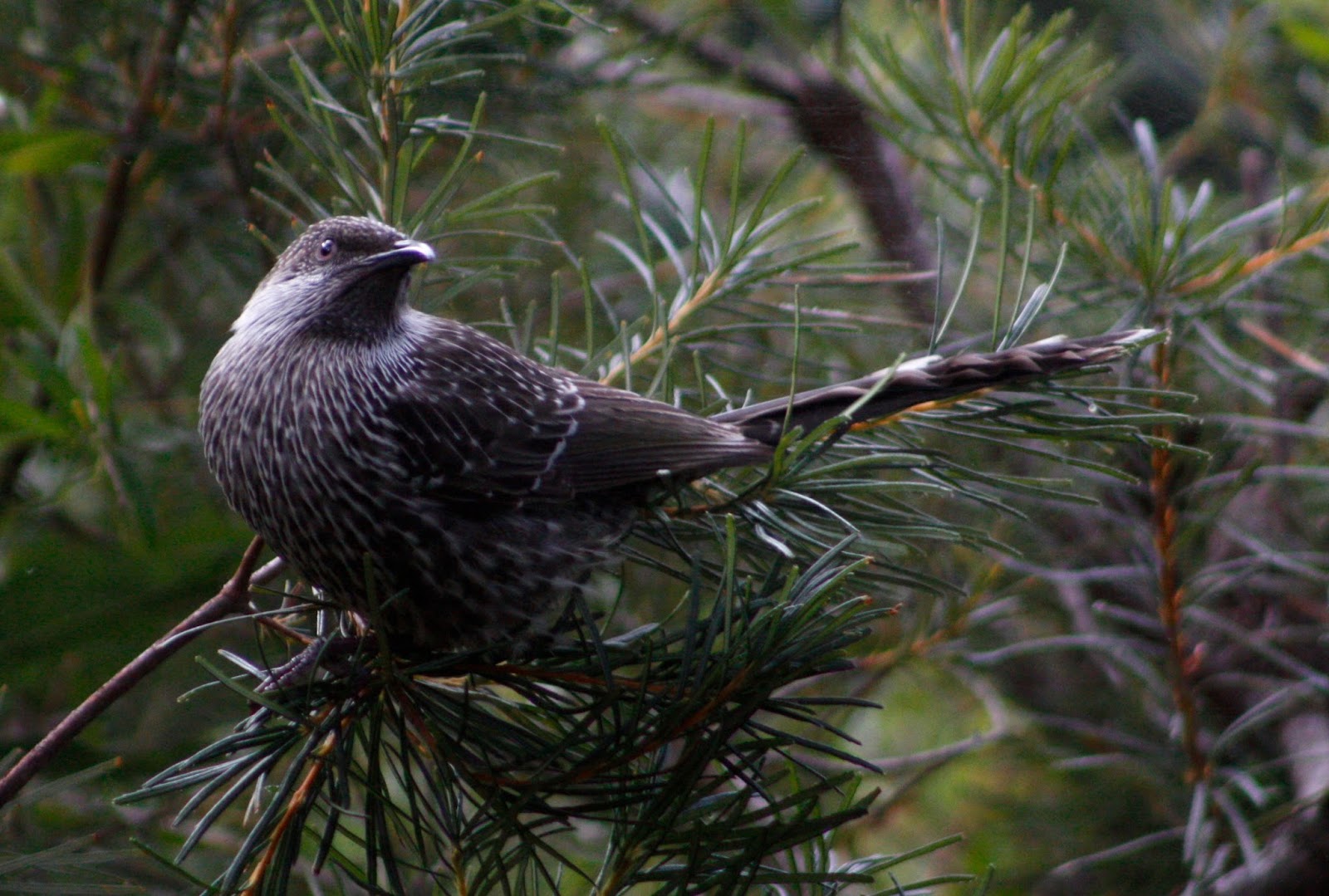
The other day this Little Wattle Bird, over an hour or two, performed quite a showy show in presumably what to him/her was a mirror. With repeated tapping at the glass, preening, head twisting, wing flapping, upside down tumble turns, loop-de-doops and sideway stretches, the whole routine was not only tireless, but tinged with a twinkly sense of humour.

Needless to say, all the best fun stuff escaped the camera, and finally I left him to it. As my mother was wont to say, 'I'll know who'll get sick of it first, and it won't be the (in the case of dog chasing ball), the dog'.


Know what I mean?


Wednesday, July 6, 2016

BACK INTO WINTER


There's a cold wind blowing today. The winters here I like: respite from summer worries (water, fires, snakes), time to cook, time to read, to slow down. And some binge viewing - we're currently hooked on Broadchurch - an improbable soap opera crime thriller with some very good performances, and some pretty bad ones. But it is well produced and good to look at. That marvellous actress who was in The Night Manager is the star (I can't be bothered to look her up at the mo) but now joined by Charlotte Rampling who costarred in '45 Years', which helped pass 20 hours in a plane, god it was miserable, the film I mean, the plane was fun, but I didn't expect to meet those hooded eyes quite so soon. She depresses me. I'm wondering if I've ever seen her smile.

Anyway - winter in the country works. The city is for summer, and shows. I had lunch at the Rocks last week - a rare day time visit - and quite frankly, at the ripe old age of blaahdy fukn blah, I am still gobsmacked by that sculpture, here in the low mid-winter northern midday sun.


So - we went to All My Sons (Sydney Theatre Company) - a fine night out and a play I've heard much about but hadn't ever seen. Nope, never. Very American I thought. I remember John Howard's John Proctor (drama theatre in that sculpture there) blowing me away (and up to Salem a year later, actually, to see for myself), not to mention catching Mr Hoffmann's Willy on Broadway, though I was way too (theatre) young to appreciate what I was experiencing.

And last Friday it was back to the Opera House for the SSO for popular programming: "Romantic Fantasies." (I'm a bit over these noms des concerts). Comparisons are inevitable after the European experiences. We now sit mid-stalls. The sound wasn't great. It's clouded, or muddied, or whatever verb I can't find. They are playing on the flat again, after the (successful) trial of raised rear platforms for all but the strings. I understand that the Hall will close soon for twelve months for a refit, and hydraulics will be installed so that these elevations can come with the press of a button to two. Brilliant.

The Korean Shiyeon Shung conducted, debuted, and while she held it all together, and they played well, I found it all a bit stiff. Vadim Gluzman's violin was another matter altogether - stunningly beautiful.

Meanwhile, front of house, the catering has changed. You can no longer buy drinks where you can buy light food so that means schlepping across to the bar balancing food (or vice versa) to get a glass of house bubbles for *eleven* (11) dollars. What? Give me a break. I saw J clutching a glass of red. She's always clutching a glass of red. It cost *fourteen* (14) dollars. I seem to remember alcohol and soft drinks being free at intervals at the Concertgebouw.


Saturday, June 11, 2016

AMSTERDAM AND THE CONCERTGEBOUW


                 (chandelier at the concertgebouw cafe - waiting for 6.15 dinner in the mirror room)


One of the great pleasures of Amsterdam is its Concertgebouw, about which I've made notes before here and here.

There are many others, not least its people whose civility and tolerance is palpable on even short stays although there appears to be cracks appearing, as in the whole European experiment, as those whom tolerance embraced now subvert the very principles that gave them succour.

As in Paris we did the AirBnB thing again (our hostess a classical pianist) in a huge apartment just outside Centrum with the Vondell Park, Museum Area and the Concertgebouw a short tram trip or a comfortable walk away. And as in Paris, it was mostly cool and showery but that suited us, escapees from the bright burning sun of a long summer. With a huge appartment, visitors from Rotterdam, and some business to attend to, we slipped into an easy and comfortable routine and we'd would be back in a heartbeat.

The street leading to the tram line into town was a daily (ex sunday) street market (mostly foods, mostly cheese and fish) and we were half a block from the old tram sheds now converted into a vast food hall, a cinema complex, specialty shops, a library, etc. It's all very cold climate - you could spend days and nights in there.


Back to the Concertgebouw, where we went to three concerts --- with three different Dutch orchestras!

The first was (I know, I know) Gergiev and the Royal Concertgebouw Orchestra playing the Beethoven Violin Concerto with Nikolaj Znaidier (who is also principal guest conductor at Marinsky) and Prokofiev's Sixth Symphony. We sat close. The Beethoven was confident and brilliantly executed, but I found it cold, unmoving. The Prokofiev (1947) I wasn't familiar with, a dark and jarring work of impossible detail.

                                                    (Nikolaj Zanier receiving the flowers)

Prior, we went to dinner in the Mirror Room, under the concert platform, not for the first time, and it was again a great pleasure.  By the way, drinks - soft, red wine, white wine, juices - are free at intervals in the Concertgebouw, and how civilised is that? Not to mention easy and time sparing.

Second was Osmo Vänakä and the Netherlands Radio Philharmonic Orchestra in an interesting programme of The Finnish composer Sebastian Fagerlund'Ignite, Bartok's second Violin Concerto with the very charismatic Greek Violinist Leonidas Kavakos, and Sibelius's 4th Symphony. I like Vänskä. Ignite was a short landscape work with apocalyptic tendencies, to my ear, and was really interesting. Mr. Fagerlund came on stage for  acclamation. The Bartok, which I read was premiered in the Concertgebouw (1939) was another new work for me, not that easy the first time, though I was rivetted on Mr Kavakos. The fourth wouldn't have been my first choice of Vanska and Sibelius (that would be the seventh) but I am incredibly grateful to have heard it live, with Vanska: it was, hardly surprisingly, completely absorbing and I felt I was hearing it the right way in the right acoustic, this mysterious introverted and uncertain work from the time of Freud and the Great War, and now will revisit it with heightened awareness.


                                            (concertmaster, Leonidas Kovakos, Osmo Vanska)

And then there was the third concert with Hartmut Haenchen and the Netherlands Philharmonic Orchestra playing Handel's Music for the Royal Fireworks followed by Shostakovich's 8th. Strange programming I thought, although the Handel seems to be one of Haenchmen's fetish pieces, and ultimately the contrast (between the pieces and their execution) was revelatory. It was a brilliant concert of impeccable musicianship led by a master, in the wonderful acoustic, the clarity can be emphasised enough, of this special place. Outstanding.


The Handel (with full orchestra) was forward, bombastic and of course celebratory, if at once pompous and terribly British. The Shostakovich was another thing altogether, and a work I've listened to but now I realise, never heard.


1943 - thats what it's all about. 1943. The pain, the anguish, the brutality, the intolerable cruelty, the idiocy, the determination, the human spirit, the aching hopeful resolution, with just a hint of uncertainty, was delivered with an intensity that was bordering on unbearable. The audience was stunned. Mute. After the applause had started, and slowly crescendoed, till the audience rose in unison, the calls went on and on, and on, and people took to the aisles to head to the stage in acclamation.

                      (Hartmut Haenchen and the Nederlands Philharmonic after Shostakovich 8th)